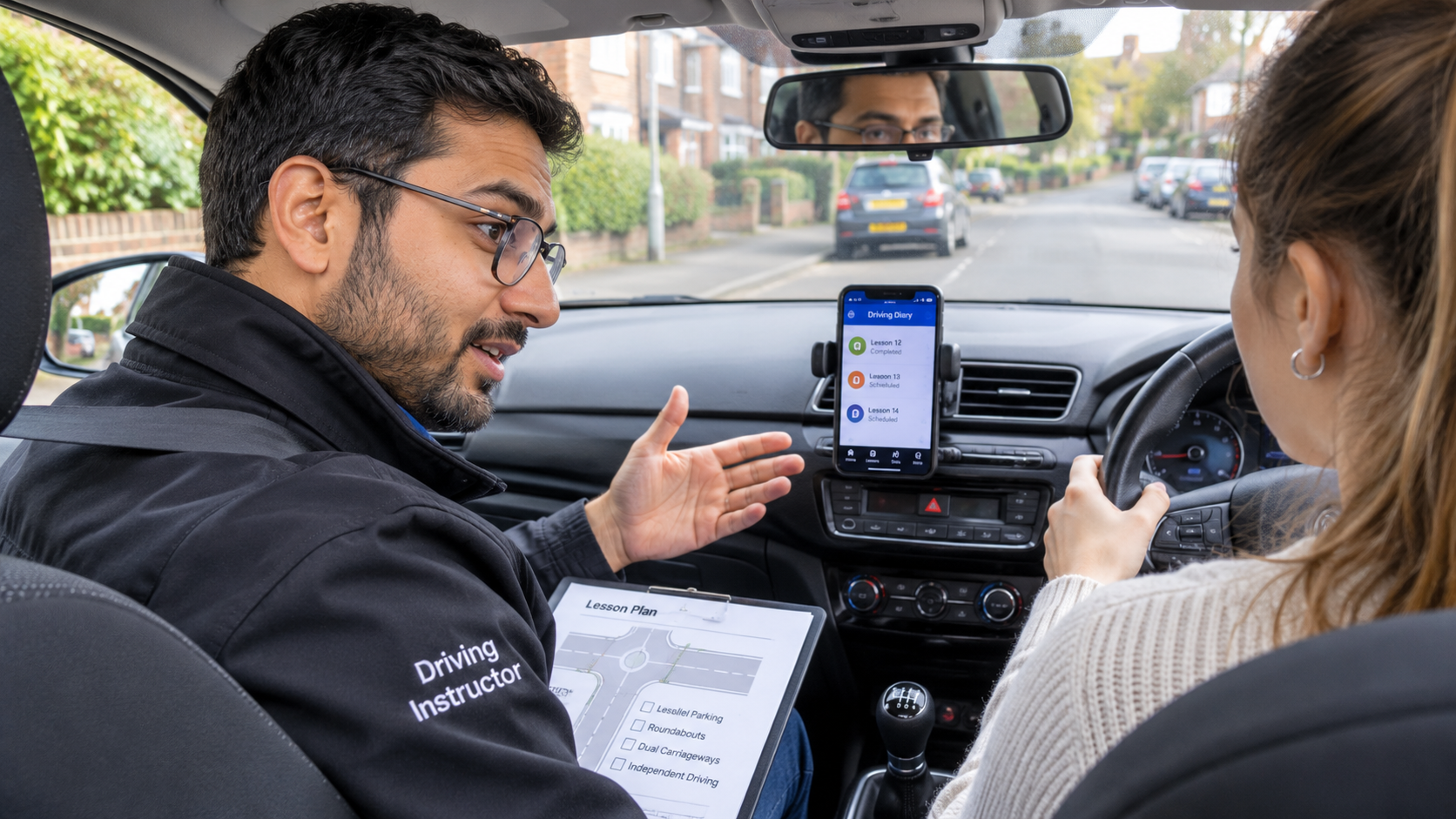
To become a driving instructor in the UK, you must be eligible (in Great Britain, at least 21 with a full licence held for three years), get a new DBS check, then pass the ADI Part 1 theory test, Part 2 driving test and Part 3 instructional test before joining the DVSA's ADI register.
If you want to know how to become a driving instructor, most of the pages you find are written by companies selling training courses. This guide is different. It sets out the official route to becoming an approved driving instructor (ADI), the order you do things in, how long it realistically takes and what you should budget for. It does not try to sell you a course.
The legal starting point is simple. You must be an ADI to charge people for driving lessons, whether you work through a driving school or set up your own business (GOV.UK). Here is how you get there.
Can you become a driving instructor? Eligibility, licence history and criminal record checks
Before you spend money on anything, check that you meet the basic requirements. To start qualifying in England, Scotland or Wales you must be at least 21, have held a full driving licence for at least 3 years, and not have been disqualified from driving in the previous 4 years (Bill Plant Driving School). Confirm the current rules on GOV.UK before you apply, because eligibility criteria can change.
Criminal record checks
You need a new Disclosure and Barring Service (DBS) check to start your application, even if you already have one from another job (GOV.UK). DVSA has to be satisfied that you are a "fit and proper person" to teach. A criminal record does not automatically rule you out, but a recent driving ban or a serious driving offence makes it unlikely you will be found fit and proper (Start Up Loans). The checks do not stop once you qualify either: you need a criminal record check every 4 years when you renew your registration (Start Up Loans).
The official order of steps
GOV.UK sets out the route as follows (GOV.UK):
- Check you are eligible.
- Get a DBS check and apply to start the process.
- Find a registered trainer (optional, but most people use one).
- Pass ADI Part 1 (theory).
- Pass ADI Part 2 (driving ability).
- Optionally, get teaching practice on a trainee licence.
- Pass ADI Part 3 (instructional ability).
- Register as an ADI.
When choosing a trainer, look for someone on DVSA's official register of driving instructor trainers (ORDIT), ask what is included in the price and be wary of packages that bundle in guarantees you cannot verify.
Northern Ireland is different. The system there is run separately. You still pass three qualifying tests: theory (Part 1), driving ability and fitness to drive (Part 2), and instructional ability (Part 3), but the fees and some rules differ (nidirect).
ADI Part 1: the theory and hazard perception test
Part 1 tests your knowledge of driving theory, the rules of the road and how to teach. It has two parts: multiple-choice questions and a hazard perception test.
The multiple-choice part has 100 questions, and you have 90 minutes to answer them. To pass, you need at least 85 out of 100 overall and at least 20 out of 25 in each of the four sections (Alan Boswell Insurance). That second requirement catches people out: a strong overall score will not save you if one section is weak.
The questions fall into four categories of 25: road procedure; traffic signs and signals, car control, pedestrians and mechanical knowledge; driving test, disabilities and the law; and publications and instructional techniques (GOV.UK). You need to know the Highway Code, DVSA's official guidance and the principles of instruction well. Hazard perception uses 14 video clips of developing hazards, with a pass mark of 57 out of 75. You must pass both elements at the same sitting.
How to prepare
- Use the official DVSA revision materials rather than relying only on question banks.
- Practise hazard perception clips regularly. The technique is different from what you may remember from your own learner days.
- Revise section by section so no single area drops below the pass mark.
There is no limit on how many times you can take Part 1, but you pay the fee each time (Bill Plant).
ADI Part 2: the driving ability test
Part 2 checks that your own driving is of a very high standard, well above what is expected from a learner on a driving test. You take it in your own suitable car.
The test includes an eyesight check, vehicle safety questions, general driving on a range of roads, manoeuvres, and a period of independent driving. Examiners expect smooth, safe, planned driving with excellent observation and control. Habits that experienced drivers pick up over years, such as crossing hands, coasting or rolling through junctions, will count against you.
Most candidates benefit from a few sessions with a trainer to strip out bad habits before booking. Check the current fee and booking details on the GOV.UK step-by-step guide.
The time limit to keep in mind
Once you pass Part 1, the clock starts. You must pass Parts 2 and 3 within 2 years, and you get 3 attempts at each (GOV.UK). If you run out of time or attempts, you have to go back and start again from Part 1. Check the current limits on GOV.UK before you book, and plan your training so you are not rushed at the end.
The trainee licence: pros, cons and how it works
After passing Part 2, you can apply for a 6-month trainee licence that lets you get paid teaching experience before Part 3. It costs £140 (GOV.UK). It is optional: you can go straight to Part 3 if you prefer.
A trainee licence is usually linked to a sponsoring driving school, and it comes with conditions, such as supervision or extra training, set by DVSA. Read the current conditions carefully before applying.
Pros
- You earn while you prepare for Part 3.
- You teach real pupils at different stages, which is the best preparation for an assessment based on a real lesson.
- You get a feel for the job before committing fully.
Cons
- It is an extra cost, and some schools charge franchise fees to trainees.
- Teaching full days can eat into the time you have for Part 3 training.
- The licence only lasts 6 months, and it does not stop the overall qualifying clock.
In Northern Ireland, a trainee licence cannot be used instead of registration (nidirect).
ADI Part 3: the instructional ability test and how it is marked
Part 3 assesses whether you can teach. An examiner watches you give a real lesson to a real pupil. This can be a learner or a qualified driver, but it should not be an ADI or someone who is also training to be one.
Your lesson is marked against the same framework DVSA uses for its ongoing standards checks on qualified instructors. It is grouped into three areas:
- Lesson planning: did you find out what the pupil needed and agree sensible goals?
- Risk management: did you keep the lesson safe, share responsibility clearly and intervene appropriately?
- Teaching and learning strategies: did you adapt to the pupil, give useful feedback and encourage them to reflect and learn?
The examiner gives you an overall grade, and serious failings in risk management can lead to a fail on their own. Part 3 rewards a pupil-centred approach: asking good questions, letting the pupil take ownership and adapting the plan. A rigid script delivered at the pupil does not score well.
Once you pass, you must register within 12 months (GOV.UK). It costs £300 to join the ADI register (Start Up Loans). Confirm the current fee on GOV.UK. In Northern Ireland, check the registration fee on nidirect.
What it costs and how long it takes
Cost checklist
Fees change, so treat this as a checklist and confirm every figure on GOV.UK before you budget. The confirmed figures are:
- ADI Part 1: £81, payable again for each retake (Bill Plant).
- Trainee licence: £140 (GOV.UK).
- Registration: £300 (Start Up Loans).
The Part 2 and Part 3 tests cost £111 per attempt (GOV.UK). Check GOV.UK for the current DBS check fee. The biggest variable is training, which is priced very differently from one provider to another. You should also budget for a suitable car, dual controls, specialist insurance and fuel once you start teaching.
A realistic timeline
Think in months, not weeks. A typical sequence looks like this:
- Eligibility checks, DBS check and application.
- Theory revision and Part 1.
- Driving training and Part 2.
- Optional trainee licence (6 months) alongside Part 3 training.
- Part 3, then registration within 12 months.
How quickly you move depends on test availability in your area, how much time you can give to study and whether you need retakes. Leave yourself a buffer before the qualifying time limit runs out.
| Item | When you pay | Cost | Source / where to check |
|---|---|---|---|
| DBS check | At the start of your application | Check current fee | GOV.UK |
| ADI Part 1 theory test | Each attempt | £81 per attempt | Bill Plant; confirm on GOV.UK |
| ADI Part 2 driving test | Each attempt | £111 per attempt | GOV.UK ADI Part 2 page |
| Trainee licence (optional) | After passing Part 2 | £140 for 6 months | GOV.UK |
| ADI Part 3 instructional test | Each attempt | £111 per attempt | GOV.UK ADI Part 3 page |
| Training with a registered trainer | Throughout | Varies by provider | Compare several trainers |
| ADI registration | Within 12 months of passing | £300 (Northern Ireland: see nidirect) | GOV.UK; nidirect for Northern Ireland |
Your first months as a qualified ADI, and next steps
Passing Part 3 is the end of the exams. It is also the start of running a small business. The first months are often busier with admin than new instructors expect.
- Diary: juggling single and weekly lessons, test dates and cancellations quickly outgrows a paper diary. A digital diary and scheduling tool with clash checking saves a lot of double-booking headaches.
- Pupils: keep clear pupil records and progress notes so you know exactly where each learner is and when they are ready for test.
- Payments: block bookings, part-payments and outstanding balances are easy to lose track of. Recording payments and pupil balances as you go makes tax time far simpler.
- Admin: reminders, messages, expenses and pass rates all take time that would be better spent teaching.
Driving Instructor Manager was built to handle that business side from day one, with a companion app for pupils. You can browse the full list of features when you get closer to qualifying.
Your next steps
- Check your eligibility on GOV.UK.
- Apply for your DBS check and start the application.
- Choose a registered trainer carefully, or plan a self-study route.
- Book Part 1 once you are consistently scoring well in every section.
- Plan Parts 2 and 3 around the time limit, and decide whether a trainee licence suits you.
Frequently asked questions
How long does it take to become a driving instructor?
It usually takes several months rather than weeks. Your timescale depends on test availability, how much time you can study and practise, and whether you need retakes. Once you pass Part 1, you must pass Parts 2 and 3 within 2 years, so plan ahead.
Can I become a driving instructor with a criminal record?
A criminal record does not automatically stop you, but DVSA must be satisfied you are a fit and proper person. A recent driving ban or serious driving offence makes approval unlikely. You need a new DBS check to apply, and further checks every 4 years when you renew your registration.
Do I need a trainee licence to become a driving instructor?
No, the trainee licence is optional. It lets you teach paying pupils for 6 months after passing Part 2, which is good preparation for Part 3. It costs £140 and comes with conditions, so weigh up whether it suits your circumstances.
How much does it cost to become a driving instructor in the UK?
Confirmed fees include £81 for each ADI Part 1 attempt, £111 for each Part 2 and Part 3 attempt, £140 for an optional trainee licence and £300 for registration. Check GOV.UK for the current DBS check fee. Training costs vary widely between providers and are usually the largest expense.
Can I work for myself once I qualify as an ADI?
Yes. Once you are on the ADI register, you can work through a driving school or set up your own business. Many instructors start with a franchise and go independent later, while others go independent from the start.
Is becoming a driving instructor different in Northern Ireland?
Yes. Northern Ireland has its own system run separately from DVSA, although you still pass three qualifying tests. Its fees differ, and a trainee licence cannot be used instead of registration. Check nidirect for full details.